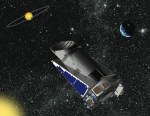
 NASA’s Kepler mission has discovered its first Earth-size planet candidates and its first candidates in the habitable zone, a region where liquid water could exist on a planet’s surface. Five of the potential planets are near Earth-size and orbit in the habitable zone of smaller, cooler stars than our sun.
Kepler also found six confirmed planets orbiting a sun-like star, Kepler-11. This is the largest group of transiting planets orbiting a single star yet discovered outside our solar system. Located approximately 2,000 light years from Earth, Kepler-11 is the most tightly packed planetary system yet discovered. All six of its confirmed planets have orbits smaller than Venus, and five of the six have orbits smaller than Mercury’s.
For more information about the Kepler Mission, please visit http://www.nasa.gov/kepler

Kepler's target region in the Milky Way. Credit: Jon Lomberg
The Kepler Mission, NASA Discovery mission #10, is specifically designed to survey a portion of our region of the Milky Way galaxy to discover dozens of Earth-size planets in or near the habitable zone and determine how many of the billions of stars in our galaxy have such planets.
David Charbonneau, an exoplanet researcher at Harvard University, explains what scientists mean when they say « earthlike planet » and « super Earth. » This interview was recorded at NASA’s Goddard Space Flight Center on December 10, 2010, by NASA science writer Daniel Pendick.


 Un monde à découvrir
Posted on 2011/02/03
0